Approved by
Order of the Federal
Environmental, Industrial
and Nuclear Supervision Service
dated 30 November 2017 No. 514
IN THE FIELD OF NUCLEAR ENERGY USE "RECORD OF EXTERNAL
NATURAL AND HUMAN-INDUCED IMPACTS
ON NUCLEAR FACILITIES"
(NP-064-17)
I. Purpose and scope
1.1. These federal standards and regulations in the field of nuclear energy use "Record of external natural and human-induced impacts on nuclear facilities" (NP-064-17) ("the Rules") are developed in accordance with article 6 of Federal Law dated November 21, 1995 N 170-ФЗ "On nuclear energy use" and the Decree of the Government of the Russian Federation dated December 1, 1997 N 1511 "On approval of Regulations on development and approval of federal standards and regulations in the field of nuclear energy use" (Code of the Russian Federation legislation, 1997, N 49, st. 5600; 2012, N 51, st. 7203).
1.2. The Rules establish requirements for record of external natural and human-induced impacts (hereinafter external impacts) on nuclear installations, radioactive sources, storage facilities for nuclear materials and radioactive substances, repositories of radioactive waste of categories I and II by radiation hazard (nuclear facilities) during their deployment, design, construction, operation and decommissioning (closure), including requirements for:
engineering surveys and studies of processes, phenomena and factors of natural and human-induced origin;
ensuring nuclear facility stability and safety under external impacts;
engineerin protection of a nuclear facility from external impacts;
monitoring of external impacts.
1.3. The Rules do not apply to:
transport and transportable nuclear installations, as well as vehicles and transportable means for transportation of nuclear materials, radioactive substances and radioactive waste;
external impacts from deliberate (terrorist, sabotage) actions and at the time of hostilities.
1.4. Procedure for bringing nuclear facilities into compliance with the requirements of these Rules, including terms and scope of required activities, is determined in each specific case in the site, construction, operation or decommissioning (closure) license conditions.
1.5. The list of abbreviations, terms and definitions are presented in Appendices 1 and 2 hereto.
II. General
2.1. Engineering surveys and studies in the nuclear facility deployment area and the site must involve establishing the nomenclature of processes, phenomena and factors of natural and human-induced origin that can affect the safety of the nuclear facility.
2.1.1. Hydrological and meteorological processes and phenomena:
flood;
tsunami;
ice-related fenomena in watercourses;
conditions of the coastal area of water bodies;
seiches;
tides;
changes in water resources: extremely low flow, abnormal decrease in water level;
tornado;
wind, hurricane;
tropical cyclone (typhoon);
precipitation;
extreme snowfalls and snowpacks;
air temperature;
snowslide;
glaze ice;
lightning stroke.
2.1.2. Geological and engineering-geological processes and phenomena:
fissure seismic and tectonic displacements, seismic dislocations, seismic and tectonic upheavals and settling of crustal blocks;
modern differential crust movements including tectonic creep;
present-day crustal motion;
residual seismic deformations of crust;
earthquakes (of any genesis);
volcanic eruption;
mud volcanism;
soil slips;
earthfalls and earth slip-falls;
mudflows;
snow and stone avalanches, crushed and block stone avalanches;
erosion by water of shores, slopes and streams;
sinks and subsidences;
underground erosion including karst formation;
Freeze-thaw geological (cryogenic) processes;
deformation of specific soils (karst, thermokarst, dilution, solifluction, suffusion processes);
Eolian processes (deflation, blowoff and barchan formation);
corrosion aggressiveness of ground and other waters
depth of groundwater level;
climatic (solar) thermal destruction;
atmospheric corrosion.
2.1.3. Factors creating external biological phenomena.
2.1.4. Factors creating external impacts of human induced origin (human induced factors):
crash of an aircraft or other missiles;
fire due to external reasons;
on-site explosion;
radiation accident;
discharges of explosive, flammable and toxic vapors, gases and aerosols into the atmosphere, drifting cloud explosion.
corrosive liquid discharged into surface and groundwater;
electromagnetic radiation;
spillage of oils and petroleum products on coastal surfaces of water bodies;
breach of natural and man-made water reservoirs.
2.1.5. The nuclear facility project must establish and substantiate the values of parameters of external natural impacts with an estimated probability of occurrence in a one-year interval 10-4 or above and external human-induced impacts with an estimated probability of occurrence in a one-year interval 10-6 or above.
2.2. Arrangement and design of nuclear facility must involve establishing a hazard degree for processes, phenomena and factors of natural and human-induced origin (appendix 3 hereto).
The nomenclature of processes, phenomena and factors of natural and human-induced origin, the parameters of their impact and the hazard degree must be substantiated in the design documents ("nuclear facility project") and presented in the safety analysis report ("SAR")
2.3. Depending on the hazard degree of external impacts on the nuclear facility presented in appendix 3 hereto, a class of the nuclear facility site under consideration must be established and substantiated:
class A nuclear facility site - a site, where there are no external impacts of hazard degree I or II, but there are external impacts of degree III;
class B nuclear facility site - a site, where there are no external impacts of hazard degree I, but there are external impacts of hazard degrees II and III;
Class C shall denote the sites which feature external impacts of hazard degree I, II and III.
2.4. For mitigation of adverse consequences of external impacts, selection of a nuclear facility site, preference must be given to sites of classes A and B.
2.5. The nuclear facility project must provide for and substantiate technical means and organizational measures aimed at ensuring the resistance of safety-related nuclear facility systems and components to external impacts installed in the area and on the nuclear facility deployment site.
2.6. Construction, operation and decommissioning (closure) of nuclear facility, organizational and technical measures must be implemented and fulfilled that are aimed at ensuring the resistance of safety-related nuclear facility systems and components to external impacts installed in the nuclear facility deployment area and on the nuclear facility deployment site.
2.7. Deterministic and probabilistic safety assessments must involve taking into account external impacts of natural and human-induced origin. At deterministic assessment of design basis accidents, within initiating events, natural external impacts must be considered having an estimated probability of occurrence in a one-year interval 10-4 or above and external human-induced impacts with an estimated probability of occurrence in a one-year interval 10-6 or above.
2.8. The nuclear facility project must involve analysis of beyond design basis accidents caused by external impacts of an intensity exceeding the intensity of impacts considered in the nuclear facility project, as well as combinations of the above impacts.
2.9. Information on interdependent processes, phenomena and factors of natural and human-induced origin detected in the course of engineering surveys and studies shall be specified in the nuclear facility project. A tentative list of interdependent processes, phenomena and factors of natural and human-induced origin is presented in appendix 4 hereto. Presence or absence of such processes, phenomena and factors shall be substantiated. In case of the presence of interdependent or mutually conditioned processes, phenomena and factors of natural and human-induced origin, analysis of their impact of the NPP safety must be performed.
2.10. Assessment of resistance of the nuclear facility buildings, structures, systems (components) under external impacts in the nuclear facility project must be exercised based on a conservative approach.
2.11. The nuclear facility project must provide for systems for automatic or automated registration of intensity of external impacts affecting the nuclear facility safety.
2.12. For nuclear installations, for which designed external impacts of hazard degree I with a dynamic nature of implementation are adopted in the project, the nuclear facility project must provide a system of seismometric control and signaling related to the automated shutdown system of the nuclear installation.
2.13. Automatic shutdown systems of nuclear installations must perform their designated functions in cases where reference levels of external impact intensity with a dynamic nature of their implementation are exceeded at places of installation of sensors (indicators) for registration of external impacts. At the same time, measures must be taken to identify and establish the type of external impacts and measures for preventing false actuation of automated shutdown systems.
2.14. The nuclear facility shall be shutdown automatically or manually in case of a dynamic natural or human induced external event on the nuclear facility site (earthquake, external explosion and aircraft crash) when the reference levels of external event intensity, adopted in the design, are exceeded. Numeric values of parameters adopted as reference levels shall be justified in the design and referenced in the nuclear facility safety analysis reports.
2.15. If a natural or human induced dynamic process, phenomenon or factor with intensity corresponding to Hazard Degree I or II has occurred at the nuclear facility site the surveys and analysis of conditions of nuclear facility buildings, structures, systems and components shall be carried out to assess the possibility of their further safe operation.
III. Requirements to identification and assesment of paremeters of external
impacts and record of the same in the project
3.1. At engineering surveys and studies in the area of arrangement of nuclear facility and on the nuclear facility site, external impacts must be recorded and identified based on information on the position of the source of external impact, its intensity and probability of occurrence.
Information sources for detection and identification of external processes, phenomena and factors of natural and human-induced origin are presented in Appendix 5 hereto. The list of the main parameters of external impacts, processes, phenomena and factors of natural and human-induced origin considered in the nuclear facility project is presented in appendix 6 hereto.
3.2. The nuclear facility project must consider results of engineering surveys and studies in the nuclear facility deployment area and on the nuclear facility site that contain information on parameters of processes, phenomena and factors of natural and human-induced origin, subject to:
level of exploration of the nuclear facility deployment area and the nuclear facility site;
layout and conditions of deployment of nuclear facility;
time of construction of nuclear facility;
time of operation and decommissioning of nuclear facility.
3.3. The scope and composition of engineering surveys and studies of the nuclear facility deployment area and the nuclear facility site must be sufficient for:
detection of external impacts affecting the safety of nuclear facility;
identification of the maximum values of intensity of external impacts, the probability of their occurrence, the safe distance from sources of external impacts to the nuclear facility site;
establishing the hazard class of external impacts and the nuclear facility site class;
taking into account interrelations between external impacts and forecasdt of their development at construction, operation and decommissioning of nuclear facility.
Results of engineering surveys and studies of the nuclear facility deployment area and the nuclear facility site must be considered in the nuclear facility SAR and updated based on results of monitorin of parameters of processes, phenomena and factors of natural and human-induced nature at construciton, operation and decommissioning of NP in accordance with the monitoring program.
3.4. For each external impact considered in the nuclear facility project, there must be prepared a separate list of the nuclear facility project, structures, systems and components subject to analysis of resistance to this external impact.
The list must include the nuclear facility project, structures, systems and components, whose damage as a result of external impact can result in a failure of the nuclear facility safety-related systems and components.
3.5. Analyses of resistance of the nuclear facility project, structures, systems (components) entered on the list must be performed for each independent external impact and with consideration of its possible mutually conditioned combination and interaction with other external impacts adopted in the project.
3.6. Designed limits of resistance under loads from external impacts including loads from effects of their mutually conditioned combination and interaction must be established and substantiated in the nuclear facility project for the nuclear facility project, structures, systems (components) entered on the list. Designed criteria of resistance of the nuclear facility project, structures, systems (components) must be substantiated with theoretical and experimental methods, with consideration of engineering and layout solutions, the record of operation of the nuclear facility.
3.7. The results of analysis of resistance of the nuclear facility project, structures, systems and components according to the list mentioned in p. 3.4 hereof must contain substantiations of non-exceeding designed limits:
relative and absolute deformations of construction structures;
subsidence and tilting of buildings and structures with consideration of current-day crust (surface) displacements on the deployment site;
thermal and corrosion resistance of materials;
strength and durability;
tightness and impermeability (gas-, dust- and smoke-impermeability) of internal volumes of buildings and structures;
construction structures, systems (components) characterizing operability;
fire resistance.
The list of analyzed designed limits and the scope of performed analyses is substantiated in the nuclear facility project.
The logical chart of the procedure for the nuclear facility safety analysis at natural and human-induced impacts is presented in appendix 7 hereto.
3.8. Analysis of resistance of buildings, structures, systems (components) must be performed with using approved analysis and calculation methods, and with attested software tools.
3.9. For each newly designed nuclear facility, the safety must be ensured subject to:
maximum horizontal accelerations amax at least 0.1 g at the level of free surface of the site ground;
ASW loads on the nuclear facility systems and components subjected to impact of ASW, with the frontal pressure at least 10 kPa, with the compression phase time within 1 sec;
ensuring fire resistance not below class I for buildings, structures and fire compartments containing safety systems (components);
stability of the localizing system protective structures to local impact loads produced by crash of aircraft and other missiles, which are equal to and not less than, in the contact area, the impact loads produced by crash of a light airplane (5 t);
spatial physical separation of channels of safety systems.
IV. Requirements to engineering protection of the nuclear
facility
4.1. The nuclear facility project must provide for organizational and technical measures for engineering protection, prevention and mitigation of adverse consequences of external natural and human-induced impacts of hazard classes I and II, subject to scenarios of their development and interrelations.
At places of possible manifestations of external impacts of hazard degrees I and II in the area of the nuclear facility deployment and on the nuclear facility site, measures must be implemented for preventing temporary obstacles (landslides, avalanches, inundations, sinkholes, tectonic faults) on evacuation routes, and alternative escape routes must be provided.
4.2. Organizational and technical measures for engineering protection of nuclear facility from external impacts must be substantiated in the nuclear facility project. Technical measures for engineering protection of nuclear facility must be taken subject to the record of their application and the record of analysis of consequences of high intensity exetrnal impacts that took place in the past. The sufficiency of adopted technical solutions for engineering protection of nuclear facility must be substantiated in the nuclear facility project subject to the maximum values of parameters of external impacts considered in the nuclear facility project with theoretical methods and tests of the nuclear facility project, structures, systems (components), as well as with consideration of the previous record of operation.
The list of organizational and technical measures for engineering protection of nuclear facility from external impacts substantiated in the nuclear facility project must be presented in the nuclear facility SAR. A tentative list of organizational and technical measures for engineering protection of nuclear facility from external impacts is given in Appendix 8 hereto.
V. Requirements to record of external impacts at operation
and decommissioning (closure) of the nuclear
facility
5.1. For ensuring the safety in the course of commissioning of the nuclear facility, dynamic characteristics (fading and natural vibration frequencies) of safety-related systems and components (except for buildings and structures) must be determined. The composition and scope of experimental determination of dynamic characteristics of safety-related systems and components must be established and substantiated in the nuclear facility project.
5.2. For nuclear facilities in operation the dynamic characteristics of safety-related systems and components shall be determined by calculations and then verified by studies or tests when operated at a nuclear facility that has been shut down and brought into safe state (for example, during a scheduled outage of a nuclear facility). Data on the updated dynamic characteristics of the nuclear facility components (systems and components) shall be used in the nuclear facility safety analyses and reflected in the relevant safety analysis reports.
5.3. Technical measures for protection of safety-related nuclear facility project, structures, systems (components) from external impacts must be developed in the project, implemented at the stage of construction and fulfilled at operation and decommissioning (closure) of the nuclear facility.
5.4. In the nuclear facility decommissioning (closure) project, measures must be provided for ensuring resistance of buildings, structures, construction structures, systems and components of nuclear facility subject to parameters of external impacts forecast at the stage of decomissioning (closure) of nuclear facility.
5.5. For assessment of possibility of further safe operation of a nuclear facility after implementation on the site of an external impact of hazard degree I or II, examination must be performed of the condition of the nuclear facility project, structures, systems and components, and the examination results must be analyzed.
5.6. At operation and decommissioning (closure) of a nuclear facility, monitoring of processes, phenomena and factors of natural and human-induced origin must be exercised by means of:
assessment and forecasting of technical condition of safety-related buildings, structures, construction structures, including assessments and forecasts of tilting and subsidence of these buildings;
periodic inspections and tests of protective features (seismic insulation, isolators, etc.), fire protection systems and bunds on the nuclear facility site.
VI. Requirements to monitoring of external impacts
6.1. In the area and on the site of nuclear facility, from the beginning of construction of the nuclear facility, during its operation and decommissioning (closure), monitoring must be exercised of parameters of natural processes, phenomena and factors, as well as periodic control of parameters of external impacts of human-induced origin, the condition of foundations, construction structures and engineering support systems.
6.2. Monitoring of parameters of processes, phenomena and factors of natural and human-induced origin must be exercised subject to data of global and uniform national monitoring systems in effect in the Russian Federation, and include the following types of monitoring:
radiation;
meteorological;
aerological;
hydrological;
hydrogeological;
geotechnical monitoring of foundation grounds including observations of tilting and subsidence of nuclear facility project and structures;
seismological;
geodynamic monitoring of current-day earth surface motions;
period control of parameters of external human-induced impacts.
6.3. The scope and composition of external natural impacts as well systems of monitoring and control of human-induced impacts required for fulfillment of the same, must be established and substantiated in the nuclear facility project, subject to results of engineering surveys and studies, within which regime observations of parameters of processes, phenomena and factors of natural and human-induced origin are fulfilled.
6.4. If Hazard Degree I and II natural processes and phenomena may occur at the nuclear facility site, the systems for monitoring of their parameters shall be operable before commissioning of the nuclear facility.
6.5. The monitoring systems shall perform the designated functions in accordance with design requirements during the entire life of the nuclear facility.
6.6. Information on natural and human-induced external impacts must be updated all across the stages of the nuclear facility lifecycle and be presented in the nuclear facility SAR, in particular, at periodic nuclear facility safety assessment.
6.7. For monitoring of parameters of processes, phenomena and factors of natural and human-induced origin, measuring means and systems of an approved type that have passed verification must be used. Results of measurements must be expressed in units of values approved for use in the Russian Federation. Measuring means and systems for monitoring and periodic inspection of parameters of processes, phenomena and factors must be subjected to verifications. The verification frequency must be established in the design documentation of the monitoring and periodic inspection systems and must be sufficient to ensure their fail-free operation between verifications.
6.8. The results of monitoring of natural processes and phenomena must be used jointly with data of state monitoring systems that are available in the Russian Federation and located in the nuclear facility deployment area.
Appendix 1
to federal rules and regulations
in the field of nuclear energy use
"Record of external impacts
of natural and human-induced origin on nuclear
nuclear facilities",
approved by Order of the Federal
Environmental,
Industrial and Nuclear Supervision Service
dated 30 November 2017 No. 514
|
NPP |
- |
nuclear power plant |
|
PSA |
- |
probabilistic safety assessment |
|
ASW |
- |
air shock wave |
|
MSSE |
- |
maximal safe shutdown earthquake |
|
MSK-64 |
- |
Medvedev–Sponheuer–Karnik seismic intensity scale |
|
NF |
- |
nuclear facility |
|
SAR |
- |
safety analysis report |
|
amax |
- |
maximum acceleration of ground on free surface |
Appendix 2
to federal rules and regulations
in the field of nuclear energy use
"Record of external impacts
of natural and human-induced origin on nuclear
nuclear facilities",
approved by Order of the Federal
Environmental,
Industrial and Nuclear Supervision Service
dated 30 November 2017 No. 514
1. Biological phenomena are phenomena occurring in wildlife and characterized by rhytm and periodicity.
2. Natural impact means an impact caused by natural phenomena, processes and factors that is external with regard to nuclear facility.
3. Human-induced impact means an impact external with regard to the nuclear facility, caused by human activities directly or as a result of using equipment and technologies at facilities located both within and beyond the nuclear facility site. <*>
--------------------------------
<*> Examples of sources located within the limits of the nuclear facility site are the NPP power units with regard to other power units of the same multi-unit NPP, or offsite equipment of the NPP with regard to the NPP power unit.
4. Gradient of rate of tectonic motions is a change in the amplitude of tectonic displacement of marking surface on a unit of distance in a unit of time.
5. Hail hazard of territory is a characteristic of territory that is determined by the frequency of hail events, areas covered by hail, extent of damage and losses caused by hail.
6. Beyond design basis accident is an accident caused by initiating events not considered for design basis accidents or accompanied by additional failures of safety system components as compared to design basis accidents in excess of a single failure and implementation of erroneous decisions of employees (personnel).
7. Engineering protection of a nuclear facility is a set of technical and organizational measures to protect the nuclear facility project, structures, systems, components and employees (personnel), prevention of accidents resulting in releases of radionuclides into the atmosphere and/or discharges of radionuclides into the environment, prevention or mitigation of social and economic losses under external natural and/or human-induced impacts.
8. Current-day crust motions are motions of the Earth crust that have been occurring in neogen-quaternary period of geological development of the Earth.
9.The nuclear facility site is a territory within a guarded perimeter accommodating the nuclear facility project and structures.
10. Fire due to external causes is a fire that broke out beyond the nuclear facility limits, which can result in external impact on the nuclear facility.
11. Sinkhole is subsidence of the ground surface as a result of variation in properties of the Earth crust rocks.
12. Dust (sand) storm is a variety of dry hot wind characterized by strong wind that carries huge masses of soil and sand particles over long distances.
13. Safe distance is taking a source of hazard away from the nuclear facility, beyond the limits of which one may ignore effects of this source of external effects of natural or human-induced origin on the nuclear facility safety.
14. The nuclear facility deployment area is a territory including the nuclear facility site, where phenomena, processes and factors of natural and human-induced origin that can affect the nuclear facility safety are possible.
15. Resistance (stability) of a system (component) under external impacts is the capacity of the system (component) to perform functions related to ensuring the nuclear facility safety under natural and/or human-induced external impacts considered in the nuclear facility project (seismic resistance, vibration resistance, corrosion resistance).
Appendix 3
to federal rules and regulations
in the field of nuclear energy use
"Record of external impacts
of natural and human-induced origin on nuclear
nuclear facilities",
approved by Order of the Federal
Environmental,
Industrial and Nuclear Supervision Service
dated 30 November 2017 No. 514
EXTERNAL NATURAL AND HUMAN-INDUCED PROCESSES, PHENOMENA
AND FACTORS, THEIR POSSIBLE CONSEQUENCES AND HAZARD DEGREES
|
Process, Phenomenon, Factor |
Possible Impacts on Nuclear Facility Site, Including Nuclear Facilities |
Parameter Ranges to Determine Hazard Degree Categories <+> |
Hazard degree by consequences to the nuclear facility |
|
I. Hydrological and meteorological processes and phenomena |
|||
|
Flood |
Flooding of the nuclear facility deployment site Hydrochemical and dynamic effects on buildings, structures and networks |
Flooding level above the layout site elevation is 1 m and more, or water flow speed equals to or higher than 0.7 m/s |
I |
|
Flooding level above the layout site elevation is less than 1 m yet over 0.2 m, or water flow speed is less than 0.7 m/s |
II |
||
|
Flooding of the nuclear facility deployment site |
Flooding level above the site layout elevation is 0.2 m and less |
III |
|
|
Tsunami |
Wave swash, temporary water level rise in the land's coastal area. Flooding of the nuclear facility deployment site Wave backwash, temporary water level reduction in the coastal area of a water body. Erosion of banks, possible inntensification of landslides on sleep banks. Dynamic effects on buildings and structures of nuclear facilities |
Flooding level caused by tsunami swash is higher than the layout site elevation by 1 m or more |
I |
|
Wave swash, temporary water level rise in the land's coastal area. Flooding of the nuclear facility deployment site Temporary water level reduction in the coastal area of a waterbody. Dynamic effects on buildings and structures of nuclear facilities |
Flooding level caused by tsunami swash is higher than the layout site elevation by less than 1 m but more than 0.2 m |
II |
|
|
Flooding level caused by tsunami swash is higher than the layout site elevation by 0.2 m or less |
III |
||
|
Watercourse icing (ice jams, ice gorges) |
Overflooding ofthe nuclear facility site, dynamic effects on buildings and structures of nuclear facilities in case of breaking wave occurrence |
Flooding level is higher than the layout site elevation by 1 m or more |
I |
|
Flooding of the nuclear facility site, dynamic effects on buildings and structures of nuclear facilities in case of breaking wave occurrence; obstruction and clogging of water receiving devices and pipelines of nuclear facilities due to the piling up slush and ice chips |
Flooding level above the layout site elevation is less than 1 m but more than 0.2 m |
II |
|
|
Flooding level is higher than the layout site elevation by 0.2 m or less |
III |
||
|
Conditions of the coastal area of waterbodies |
Flooding of the nuclear facility deployment site Dynamic impacts on vertical- and slope-section waterworks Flowing around obstacles and through structures |
The level of flooding is equal to or more than 1.0 m |
I |
|
The level of area flooding is lower than 1 m but higher than 0.2 m |
II |
||
|
Flooding level is 0.2 m or lower |
III |
||
|
Seiches |
Flooding of the nuclear facility deployment site |
Flooding level is higher than the layout site elevation by 1 m or more |
I |
|
Flooding level above the layout site elevation is less than 1 m but more than 0.2 m |
II |
||
|
Flooding level is higher than the layout site elevation by 0.2 m or less |
III |
||
|
Tides |
Flooding of the nuclear facility deployment site |
Flooding level is higher than the layout site elevation by less than 1 m but more than 0.2 m |
I |
|
Flooding level above the layout site elevation is less than 1 m but more than 0.2 m |
II |
||
|
Flooding level is higher than the layout site elevation by 0.2 m or less |
III |
||
|
Changes in water resources: extremely low drainage, anomalous water level reduction, including ebbs |
Water level reduction in the surface sources of service water supply of nuclear facilities |
Water level reduction in the surface sources of service water supply of nuclear facilities is more than 0.2 m against minimum monthly average levels at 95% probability |
II |
|
Water level reduction in the surface sources of service water supply of nuclear facilities is 0.2 m or less against minimum monthly average levels at 95% probability |
III |
||
|
Tornado |
The wind pressure on buildings and structures The loads from the pressure drop between the periphery and the center of the whirl Loads from missiles carried by whirlwind. Water carryover from cooling process water pools |
Tornado intensity class is F2.00 and higher; |
I |
|
Tornado intensity class is less than F2.00 yet higher than F0.00 |
II |
||
|
Tornado intensity class F0.00 |
III |
||
|
Hurricane |
Wind pressure Missiles |
Average wind speed of 32 m/s or more with 10-minute smoothing |
I |
|
Wind |
Wind pressure Missiles |
Average wind speed of less than 32 m/s but 7 m/s or higher with 10-minute smoothing |
II |
|
Average wind speed of less than 7 m/s with 10-minute smoothing |
III |
||
|
Typhoon, tropical cyclone |
The wind pressure on buildings and structures Shower precipitation |
Rainfall intensity of 30 mm/h or more and wind speed of 32 m/s or more with 10-minute smoothing |
I |
|
Atmospheric precipitations |
Site flooding |
Rainfall intensity of 50 mm or more over 12 h or less (mudflow hazardous areas: 30 mm or more over 12 h or less) |
I |
|
Rainfall intensity of less than 50 mm yet more than 30 mm over 12 h or less |
II |
||
|
Rainfall intensity of 30 mm or less over 12 h or less |
III |
||
|
Snowslide |
Dynamic pressure of snow - ASW |
Depth of vertical relief fragmentation 500 to 1000 m, average maximum thickness of show layer 70 to 100 cm, avalanche speed 20 m/s or more, avalanche run-out distance 1000 m or more |
I |
|
Dynamic pressure of snow |
Depth of vertical relief fragmentation 500 or less, average maximum thickness of show layer 70 cm, avalanche speed less than 20 m/s, avalanche run-out distance less than 1000 m. |
II |
|
|
Glaze frost |
The destruction of the supports of communication and power supply lines and failure of the systems of communication and power supply due to coating with ice and frost |
Glaze-ice wall thickness of 25 mm or more |
I |
|
Weighting of structures constructions due to the coating with ice or frost |
Glaze-ice wall thickness of less than 25 mm yet more than 3 mm |
II |
|
|
Glaze-ice wall thickness of less than 3 mm |
III |
||
|
II. Geological and engineering-geological processes and phenomena |
|||
|
Modern differential crust movements including tectonic creep |
Ground surface deformations and change in the stressed state of base soils |
Geodynamic zones with the velocity gradient of modern differential movements of the ground surface of 10-5 1/year or more |
I |
|
Geodynamic zones with the velocity gradient of modern differential movements of the ground surface of 10-8 to 10-5 1/year |
II |
||
|
Geodynamic zones with the velocity gradient of modern differential movements of the ground surface of less than 10-8 1/year |
III |
||
|
Current-day (neogen-quaternary) Earth crust motions |
Ground surface deformations and change in the stressed state of base soils |
Geodynamic zones with the velocity gradient of modern movements of -6 1/year and more |
I |
|
Geodynamic zones with a velocity gradient of modern movements from 10-9 to 10-6/year |
II |
||
|
Geodynamic zones with the velocity gradient of modern movements less than 10-9 1/year |
III |
||
|
Fissure seismic and tectonic displacements, upheavals and settling of crustal blocks |
Surface tectonic fissures accompanied by strong vibrations |
Fissure displacements with an amplitude of 0.3 m or more |
I |
|
Residual seismic deformations of crust: |
|
|
|
|
- in the zones of tectonic faults with their width of over 10 m, during earthquakes with their intensity of at least VII points as per MSK-64 scale; |
Cracks, step depressions, thrust folds, soil eruptions, settlements and earth waves formed by the passage of seismic waves |
Displacements with an amplitude of 0.3 m or more |
I |
|
- in areas of water-logged grounds; |
Cracks. Depressions. Base deformations |
Displacements with an amplitude of 0.1 m or more |
I |
|
- in zones of tectonic disturbances with suspended tectonic movements; |
Irregular depressions due to the heterogeneity of the rocks at the base of structures crossing the zone |
Base scraps is less than 0.3 m, but more than 0.1 m; Base scraps is less than 0.3 m, but more than 0.1 m; displacements with an amplitude of less than 0.3 m, but greater than or equal to 0.1 m |
II |
|
- on smooth slopes and in the areas bearing seismic deformation signs during earthquakes with their intensity of at least 7 points as per MSK-64 scale; |
Cracks Subsidence Soil base deformation |
Displacements with an amplitude of less than 0.3 m, but greater than 0.1 m |
II |
|
- in the zones of tectonic disturbances, on the slopes and in the depression areas with thawed soils during shakes caused by massive explosions and earthquakes with their intensity below VII points as per MSK-64 scale |
Soil base deformation |
Base scraps is less than 0.3 m, but more than 0.1 m; displacements with an amplitude of less than 0.3 m, but greater than or equal to 0.1 m |
II |
|
Cracks Subsidence Soil base deformation |
Displacements with an amplitude of less than 0.1 m |
III |
|
|
Earthquakes of any genesis |
Structural oscillations. Soil base deformations Subsidence Changes in ground water regime |
Intensity of the SEE level of at least 8 points as per MSK-64 scale (amax |
I |
|
Intensity of the SEE level of 6-7 points as per MSK-64 scale (0.05 g |
II |
||
|
Intensity of the SEE level of less than 6 points as per MSK-64 scale (amax < 0.05 g) |
III |
||
|
Volcanic eruption: |
|
|
|
|
- in the zone of discharge of volcanic bombs, lava flows and explosion impacts; |
Soil base displacements Shock and high temperature impacts Hazardous (polluting) substances |
|
I |
|
- in the zone of propagation of ashes, gases and concussions |
|
II |
|
|
Mud volcanism |
|
|
|
|
- in areas of mud spouting and gas pollution; |
Mud inundation High gas concentrations Temperature impacts Soil base deformations |
The level of flooding is equal to or more than 0.5 m |
I |
|
- in the mud flow zones |
Mud flooding |
Flooding level is lower than 0.5 m |
II |
|
Moving and suspended landslides: |
|
|
|
|
- with the depth of capture of over 5 m |
Offset of base soils |
The area of displaced substance is 10,000 m 2 or more |
I |
|
- with the depth of capture up to 5 m |
Offset of base soils |
The area of displaced substance below 10,000 m2 |
II |
|
Moving and suspended collapses |
Volume of collapsed rocks |
Over 1000 m3 |
I |
|
50 - 1000 m3 |
II |
||
|
Less than 50 m3 |
III |
||
|
Mudflows, snow- and -stone and crushed gravel- block avalanches on the slopes with steepness of: |
|
|
|
|
- 35° or more |
Shock, hydrodynamic impact |
Flow impact force is 100 t/m2 or more |
I |
|
- less than 35° |
Flow impact force is within range of 100 t/m2 - 30 t/m2 |
II |
|
|
- less than 35° |
Flow impact force is less than 30 t/m2 |
III |
|
|
Water erosion of banks, slopes and streams |
On the nuclear facility deployment site: damage and cracks of buildings and structures, subsidence, sinkholes in soil bases |
Movements of the cut line and edge of abrasion scarp of 1 m/year or more |
I |
|
Movements of the cut line and edge of abrasion scarp of less than 1 m/year but 0.1 m/year or more |
II |
||
|
Moving the cut line and edge of abrasion scarp less than 0.1 m/year |
III |
||
|
Depressions and dips of the territory, underground washouts, including carbonated karst manifestations |
On the nuclear facility deployment site: Depressions and dips of soil bases |
1 or more dips in the area of 100 km2 or less |
I |
|
1 dip (sinkhole) in the area of 100 km2 |
II |
||
|
Congelation and geologic (cryogenic) processes (frost heaving, lode ice thawing and icings) |
Soil base deformations |
Displacements with an amplitude of 0.3 m or more |
I |
|
Displacements with an amplitude of less than 0.3 m, but greater than 0.1 m |
II |
||
|
Displacements with an amplitude of 0.1 m or less |
III |
||
|
Deformations of specific soils due to the development of natural and human-induced processes (liquefaction, swelling and suffosion chemical processes of subsidence) |
Soil base deformations |
The maximum possible values determined by design are to be adopted for the site |
II |
|
Eolian processes (deflation, blowoff and barchan formation) |
Wind-related terrain change Formation of accumulative forms (e.g. barchans) and denudation forms (blowout trenches alongside desert roads) |
Presence of eolian processes on site |
II |
|
Erosion processes (gully formation) |
Collapse of rocks and soils by surface water flows, including detachment and withdrawal of material debris and their redeposition |
Presence of gully formation processes on site |
II |
|
Corrosion aggressiveness of ground and groundwater |
Destruction of construction materials (buildings and structures), equipment, pipelines and cables |
High corrosion aggressiveness |
I |
|
Medium corrosion aggressiveness |
II |
||
|
Low corrosion aggressiveness |
III |
||
|
Depth of groundwater level |
Deformation of base soils, buildings and structures |
Depth of ground water level of less than 3 m from the plan surface in the soils with their thickness of 10 m or more and their infiltration rate of 10 m/day or more |
I |
|
Climatic (solar) thermal destruction |
Damage to non-metal materials and paint coatings in the tropics and subtropics with the NPP service life of over 30 years |
Temperature and humidity characteristics of climate conditions: air humidity; annual average air temperature; daily average surface temperature;
annual average solar radiation. Impact of particular aggressive factors and their combined accelerating effect on material durability are taken into account. Determined by calculation |
II |
|
III. Factors creating external impacts of human induced origin (human induced factors) |
|||
|
Crash of an aircraft or other missiles |
Crash, spilling of fuel, fuel ignition, fire |
Possible weight of the aircraft more than 20 tons |
I |
|
Possible weight of the aircraft 5 t or more but less than or equal to 20 t |
II |
||
|
Possible weight of the aircraft less than 5 tons |
III |
||
|
Fire due to external reasons |
Hazards of fire (smoke, increasing of ambient temperature, toxic products of combustion and thermal decomposition, the low oxygen concentration) |
Impact on nuclear facilities lasting over 2 h |
I |
|
Same as above, but the impact on nuclear facilities lasts 2 h or less |
II |
||
|
Explosion at the facility |
ASW, missiles, smoke, gas, dust, accompanying fires |
ASW from pressure on nuclear facility project and structures of 30 kPa or more |
I |
|
ASW from pressure on buildings and structures of less than 30 kPa yet higher than or equal to 1 kPa |
II |
||
|
ASW from pressure on nuclear facility project and structures of less than 1 kPa |
III |
||
|
Discharges of explosive, flammable and toxic vapors, gases and aerosols into the atmosphere, drifting cloud explosion |
ASW, missiles, smoke, gas, dust, accompanying fires, ground motion |
ASW from pressure on nuclear facility project and structures of 30 kPa or more |
I |
|
ASW from pressure on buildings and structures of less than 30 kPa yet higher than or equal to 1 kPa |
II |
||
|
ASW from pressure on nuclear facility project and structures of less than 1 kPa |
III |
||
|
Discharges of toxic fumes, gases and aerosols into the atmosphere |
Increase of concentration of toxic gases and aerosols |
Design parameters exceed regulatory maximum allowable values |
II |
|
Design parameters are lower than regulatory maximum allowable values |
III |
||
|
Radiation accident |
Exposure of workers (personnel) |
Presence in the nuclear facility deployment area and/or site of other facilities, radiation accidents on which can lead to exposure of personnel above the basic radiation dose limits |
II |
|
Presence in the nuclear facility deployment area and/or site of other facilities, radiation accidents on which can lead to exposure of personnel. Basic radiation dose limits will not be exceeded |
III |
||
|
Corrosive liquid discharged into surface and groundwater |
Corrosive liquid intake into units of water cooling system from water intake areas |
Design parameters exceed the maximum permissible values |
II |
|
Design parameters do not exceed the maximum permissible values |
III |
||
|
Electromagnetic pulses and emission |
Impact of electromagnetic field on networks, equipment and staff (personnel) |
Presence on site. The parameters are determined by calculation for the specific conditions |
II |
|
Breach of natural and man-made water reservoirs |
Inundation of area. Waterway bed undermining. Dynamic impacts |
On-site wave height is of 1 m or higher, on-site water flow speed is 0.7 m/s or more |
I |
|
The wave height less than 1 m, but more than 0.2 m; water flow rate of less than 0.7 m |
II |
||
|
The wave height less than 0.2 m |
III |
||
|
IV. Factors creating external biological impacts |
|||
|
Biological phenomena affecting the nuclear facility safety |
Damage of buildings, constructions and structures |
Propagation over the nuclear facility site and coastal area |
II |


--------------------------------
<+> The factor values correspond to the probability of 10-4 and higher for natural factors and the probability of 10-6 and higher for human-induced factors.
Appendix 4
to federal rules and regulations
in the field of nuclear energy use
"Record of external impacts
of natural and human-induced origin on nuclear
nuclear facilities",
approved by Order of the Federal
Environmental,
Industrial and Nuclear Supervision Service
dated 30 November 2017 No. 514
(for reference)
OF EXTERNAL NATURAL AND HUMAN-INDUCED INTERDEPENDENT PROCESSES,
PHENOMENA AND FACTORS
|
Typical association of processes, phenomena and factors |
Form of interactions |
|
Earthquakes, landslides, earthfalls |
Activation of landslides and cave-ins due to a severe earthquake |
|
Landslides, earthfalls, flooding, fluvial or ravine erosion |
Damming by shifting landslide or earthfall masses of river valleys and ravines, the breakthrough of which leads to the formation of mudflows, increased erosion and flooding of the territory |
|
Karst, suffosion, landslides |
Activation of a karst process, accompanied by suffusion and landslide of soils in forming karst sinkholes |
|
Modification of the banks of water reservoirs, earthfalls, landslides, karst |
Modification of water reservoir banks caused by activation of earthfalls, landslides and karst phenomena |
|
Weatherting, landslides, earthfalls |
Intensive weathering of rocks increasing creep processes with transition to landslides and earthfalls |
|
Fluvial and ravine erosion, landslides, earthfalls |
Intense erosion causing activation of landslides or earthfalls. |
|
Landslides and earthfalls |
Transitions between landslide and earthfall processes |
|
Sea abrasion, landslides, earthfalls |
Intensification of sea abrasion causing activation of landslides and earthfalls |
|
Overdrying of area, subsidence of earth surface, eolian processes |
Overdrying of area causing subsidence of earth surface, eolian processes |
|
Earthquakes, geodynamic and tectonic activity |
Activation of seismic activity due to intensification of geodynamical and tectonic activity |
|
Earthquakes, variations of geotechnical properties of soils with time |
Change in the site seismicity due to changes in geotechnical properties of soils |
|
Changes in the physical and mechanical properties of soils, karst-suffosion processes and human engineering activities |
Changes in the physical and mechanical properties of soils as a result of karst-suffosion processes, flooding or drainage of the site, swelling of soils, soil compaction under load from the facility structure |
|
Earthquakes, induced seismicity (pumping of oil, gas, mining, including that of coal, rock salt, pumping of industrial waste and flooding of reservoirs, filling of reservoirs, rapid discharge of water in reservoirs) |
Deformation of earth surface |
Appendix 5
to federal rules and regulations
in the field of nuclear energy use
"Record of external impacts
of natural and human-induced origin on nuclear
nuclear facilities",
approved by Order of the Federal
Environmental,
Industrial and Nuclear Supervision Service
dated 30 November 2017 No. 514
(for reference)
OF INFORMATION FOR DETECTION AND IDENTIFICATION OF EXTERNAL PROCESSES,
PHENOMENA AND FACTORS OF NATURAL AND HUMAN-INDUCED ORIGIN
|
Hazardous Processes, Phenomena, Factors |
Sources of information |
|
I. Hydrological and meteorological processes and phenomena |
|
|
Flood |
Topographic and climatic maps, the map of hail hazard of the territory of the Russian Federation over the long-term period of climatic observations, the chart of zoning of the territory of the former USSR by tornado hazard on the scale of 1: 50 000 000 Historical data. Surface water resources. Hydrologic year-books Witness reports. Archived data Hydrological monitoring Statistical data obtained through processing of hydro- meteorological information for a long time period (not less than 50 years), which contains sets of annual parameter values and peaking data. Systematic data collected during at least one year in the area surrounding the site. The sizes of such areas shall be sufficient to take account of all regional features and factors affecting climatic conditions of the given region Measurement data obtained through standard hydro- meteorological survey programs, which provide for hourly measurements performed directly on the candidate site. Climate reference books Climate monthly and yearly books Aerial and meteorological monitoring |
|
Tsunami |
|
|
Watercourse icing (ice jams, ice gorges) |
|
|
Conditions of the coastal area of waterbodies |
|
|
Seiches |
|
|
Tides |
|
|
Changes in water resources: extremely low flow, abnormal decrease in water level |
|
|
Tornado |
|
|
Wind, hurricane |
|
|
Tropical cyclone (typhoon) |
|
|
Atmospheric precipitation |
|
|
Extreme snowfalls and snowpacks |
|
|
Air temperature |
|
|
Snowslide |
|
|
Glaze frost |
|
|
Lightning stroke |
|
|
II. Geological and engineering-geological processes and phenomena |
|
|
Fissure seismic and tectonic displacements, seismic dislocations, seismic and tectonic upheavals and settling of crustal blocks |
Russian Federation territory general seismic zoning maps Literature and archives on structural geology, tectonics, seismic tectonics, geophysics, seismology, deep-seated structure, neotectonic and modern crust movements, seismicity, paleoseismic dislocations Space and air survey images Geophysics, geochemistry and geodetic surveys including high-accuracy recurrent leveling and instrumental monitoring of modern fissure geodynamics including high-accuracy observations of micro-earthquakes Results of comprehensive geological and geophysical survey Data acquired in the course of boring, sinking, electric and seismic survey profiling, well logging. |
|
Modern differential crust movements including tectonic creep |
|
|
Residual seismic deformations of crust |
|
|
Earthquakes of any genesis |
|
|
Volcanic eruption |
|
|
Mud volcanism |
|
|
Soil slips |
Geodetic, aerospace, engineering-geological surveys and monitoring (including state monitoring) of exogenous geological processes Documents generated in the course of engineering surveys (geodetic and hydrometeorological) carried out for the purposes of constructing in the regions featuring hazardous geologic processes (including seismic regions) Documents of engineering protection from hazardous geological processes |
|
Rockfalls |
|
|
Mudflows |
|
|
Snow and stone and crushed gravel-block avalanches |
|
|
Water erosion of banks, slopes and streams |
|
|
Sinks and subsidences |
|
|
Underground erosion including karst formation |
|
|
Freeze-thaw geological (cryogenic) processes |
|
|
Deformations of specific soils due to the development of natural and human-induced processes (thermokast, liquefaction, solifluction and suffosion processes) |
|
|
III. External impacts of human induced origin (human induced factors) |
|
|
Crash of an aircraft or other missiles |
Maps containing information about the presence of airports, the locations of air corridors, intersections of air routes in the nuclear facility deployment area. information on air traffic types, types and characteristics of aircraft, frequency of flights Schemes of aircraft take-off, landing and parking. Information on the presence within the NP exposure zone of military objects or bombing grounds in use. Information on the types of any potential missiles, their characteristics and hazard occurrence probability Archive data on airplane crashes |
|
Fire due to external reasons |
Information on presence of any external fire hazard sources in the nuclear facility deployment site and on the nuclear facility site within the radius of 2 km: forestation; warehouses for explosive materials (solid, liquid and gaseous); product pipelines and oil and gas manifold pipelines; railroads and motor roads, navigable rivers and sea routes; airfields, air routes and flight lines; residential areas; industrial enterprises (with specification of the category of buildings and outdoor process installations, sites in terms of fire and explosion hazard); coal and peat extraction facilities; areas with peat deposits; surface of water areas with indicated film of oil and other oil products Archive and statistic data on fires and their causes in the nuclear facility deployment site and at the nuclear facility site for at least 5 recent years. Information on reserves of combustible materials Meteorological conditions Hydrological conditions |
|
Explosion at the facility |
Information on presence of any potential stationary and mobile explosion sources in the nuclear facility deployment site and at the nuclear facility site: warehouses and storage facilities for explosive substances within the radius of 10 km; any enterprises where hazardous technologies are applied, process-related explosions are possible and also any pressurized vessels or high-pressure plants with gases, vapors and other liquids are installed within the radius of 5 km; motorways and railways, water transport with indication of transported explosive substances and transportation vehicles within the radius of 5 km; oil and gas main pipelines, product pipelines, process equipment or pipelines for flammable gases or highly flammable liquids that can become a source of leakage resulting in formation of clouds of explosion- and fire-hazardous mixtures within the radius of 7 km; military facilities within the radius of 30 km Information on reserves of explosives Archive and statistic data on any explosions in the nuclear facility deployment site Geological conditons in the nuclear facility area and deployment site Meteorological conditions Hydrological conditions Map of external sources (in relation to the radioactive source) of explosions on the nuclear facility site |
|
Discharges of explosive, flammable and toxic vapors, gases and aerosols into the atmosphere, drifting cloud explosion |
Information on any sources of harmful (polluting) substances from chemical plants and any fire sources in the nuclear facility deployment site and at the NPP site within the radius of 7 km; Schemes of transportation of mobile sources of discharge of pollutants. Dispersion of pollutants into atmospheric air information on potential volumes of toxic substances. Meteorological conditions, including information on inversion, fogs |
|
Corrosive liquid discharged into surface and groundwater |
Maps containing information on the presence in the nuclear facility area and deployment site of industrial enterprises using chlorine, hydrogen sulfide, ammonia, sulfur dioxide and other chemically active substances, and places of chemically active discharges of these production facilities Schemes of relocation of mobile sources of corrosive hazard Dispersion of contaminations in surface and ground waters Information on possible volume of discharge (release) Archive and statistic data on discharges Hydrological conditions |
|
Electromagnetic pulses and emission |
Maps containing information about the presence of enterprises, military and other facilities characterized by electromagnetic radiation and associated with the production and use of electromagnetic fields in the nuclear facility deployment area Special information on power of sources |
|
Spillage of oils and petroleum products on coastal surfaces of water bodies |
Maps containing information on the presence in the nuclear facility deployment area and deployment site of facilities on the banks of water bodies, which may contain petroleum products and oils; on the passage of routes of ships, motor roads and railways Information on possible volumes of spillage of oils and petroleum products. The size of the stains of pollution on coastal surfaces of water bodies archival data and statistics) Meteorological conditions Hydrological dispersion of contaminations on coastal surfaces of water bodies |
|
Breach of natural and man-made water reservoirs |
Atlas of deployment of water reservoirs and nuclear facilities Topographic maps and plans, bathymetric and climate maps Seismicity of the area. Surface water resources. Hydrologic year-books. Archived data. Hydrological monitoring Probabilistic characteristics of reliability, durability and stability of hydraulic engineering structures under external impacts of natural and human-induced origin Statistical data obtained through processing of hydro- meteorological information for a long time period (not less than 50 years), which contains sets of annual parameter values and peaking data. Data on annual water level measurement in the upstream reach Statistical estimates of the maximum water storage in the upstream reach Observation data obtained through standard hydro-meteorological survey programs, which provide for hourly measurements performed on hydrological stations and posts in immediate proximity to the nuclear facility deployment site |
|
IV. Factors creating external impacts of biological origin (biological phenomena) |
|
|
Biological phenomena |
Literature and archive materials of biological observations and studies Statistical data obtained through processing of biological information for a long time period (not less than 50 years), which contains sets of annual parameter values and peaking data |
|
V. Factors of external impact as a result of a radiation accident in the nuclear facility deployment area |
|
|
Exposure of workers (personnel) |
Information on the presence in the area and/or on the deployment site of the nuclear facility of other facilities where radiation accidents are possible Transportation schemes for mobile radiation sources Information on potential volumes of radioactive substances EMERCOM information on radiation accident Meteorological conditions, including information on inversion, fogs |
Appendix 6
to federal rules and regulations
in the field of nuclear energy use
"Record of external impacts
of natural and human-induced origin on nuclear
nuclear facilities",
approved by Order of the Federal
Environmental,
Industrial and Nuclear Supervision Service
dated 30 November 2017 No. 514
(for reference)
OF MAIN PARAMETERS OF EXTERNAL IMPACTS OF PROCESSES, PHENOMENA
AND FACTORS OF NATURAL AND HUMAN-INDUCED ORIGIN
CONSIDERED IN THE NUCLEAR
FACILITY PROJECT
|
Processes, phenomena and factors |
Parameters with probability of up to 0.01% (recurrence once in 10,000 years) |
|
I. Hydrological and meteorological processes and phenomena |
|
|
Flooding (overflooding or underflooding of the site) |
Maximum flow rates and water levels of watercourses in the area of location of the facility for different probability levels Hydrographs of rain floods and spring flood of watercourses in the area of the facility. Absolute elevation of the site overflooding (underflooding) level Water flow speed For the phenomena (extreme high water or rain floods, extreme precipitation, ice jams and congestion on watercourses), the impact of water level rise on the site is estimated. In such a case: the possibility of flooding is substantiated based on the calculation of the water level during flood and (or) rise of the groundwater level; calculations of high water level, peak water flow due to precipitation, ice jams, breakthrough of water reservoirs are presented |
|
Tsunami |
Tsunami wave height Maximum positive amplitude of tsunami wave Maximum negative amplitude of tsunami wave Maximum elevations of the rise and recession of water (tsunami run-up on shore and dereliction of the shoreline at rolling back of tsunami waves) Tsunami wave dynamic impact |
|
Watercourse icing (ice jams, ice gorges) |
Absolute elevation of area overflooding level. Dynamic impact of overflooding caused by ise jams and gorges Ice thickness Dimensions of individual ice blocks Speed of ice blocks Angle of approach of ice blocks to the shore Width and extension of ice jams and gorges Probability of formation of ice jams and gorges Dates of onset of ice phases |
|
Conditions of the coastal area of waterbodies |
Calculated maximum characteristics of storm wave (height, length, wave period, level of wave top at the point of downfall, the depth of the wave downfall, maximum height of wave run-up after the downfall) of different probabilities. Absolute elevation of the area overflooding level at run-up of storm waves onto the shore Absolute elevation of shoreline dereliction at recession of storm waves Flooding area Dynamic impact of flooding from storm |
|
Seiches |
Maximum amplitude of fluctuations in the water level of the water reservoir at seiches Absolute elevation of area overflooding level |
|
Tides |
Extreme amplitudes of tide-ebb fluctuations Absolute elevation of area overflooding level. Absolute elevation of coastal area dereliction level Absolute elevation of area flooding level at combination of unfavorable factors (tides, onsets, storm waves, seiches, tsunamis, etc.) Absolute elevation of coastal strip dereliction level at combination of unfavorable factors (ebbs, offsets, storm waves, seiches, tsunamis) For the above phenomena (offset and onset of water, storm waves in the coastal zone, tsunamis, seiches, tides and ebbs), the impact is estimated of a rise or fall of the water level on the site. In such a case: calculations are presented of high water level of different probability values due to seiches, tsunamis, waves, tides, breakthrough of water reservoirs and other phenomena; calculations are presented of decline in water level of different probability values due to seiches, tsunamis, waves, offsets, ebbs and other phenomena |
|
Changes in water resources: extremely low flow, abnormal decrease in water level |
Minimum water flow Minimum water level For the above phenomena (offset of water, storm waves in the coastal zone, tsunamis, seiches, ebbs, ice jams and gorges on watercourses), the impact is estimated of a fall of the water level on the site. In such a case: calculations are presented of decline in water level due to heavy drought, seiches, tsunamis, waves, ice jams, offsets, ebbs and other phenomena |
|
Tornado |
Rated intensity class of tornado is per Fujita scale (F-scale) Length/width of tornado path (route) Maximum horizontal speed of tornado wall rotational movement Tornado travel speed Pressure difference between the periphery and the funnel rotation center Pressure drop rate Rate of water removal from process cooling pond Tornado occurrence probability Characteristics of fragments of buildings and structures caught with tornado, flying objects Values of coefficients of pressure pattern and distribution on flat surfaces and round structures of the type of containment Combination of loads at the most unfavorable impact of tornado on the structure |
|
Wind, hurricane |
Maximum observed wind speed Estimated maximum wind speeds of different probability values Estimated maximum wind speeds by altitude from 10 m to the effective height of the rise of emission into the atmosphere, the recurrence intervals of the maximum wind speed and gust coefficients Wind loads, structural vibration form coefficients, distribution of wind pressure along the height of structures (in this case, methods are described for converting wind speed into effective pressure on the wind-facing surfaces of structures) Recurrence of wind directions (wind rose) for a height of 10 m above the ground |
|
Hurricane (typhoon, tropical cyclone) |
Maximum wind speed of different probability values. Daily maximum precipitation of different probability values |
|
Atmospheric precipitations |
Height of precipitation layer: annual, monthly and daliy observed maximum precipitation; daily maximum precipitation of different probability values |
|
Extreme snowfalls and snowpacks |
Observed maximum height of snow cover on a level surface Estimated maximum snow loads (weight of snow cover per 1 m2 of horizontal surface of ground) of different probability values Snow load distribution charts Factors of snow blanket mass conversion into snow load on the surface |
|
Air temperature |
Maximum and minimum observed temperatures Estimated maximum and minimum air temperatures of different probability values Change in average temperature and temperature differential over time in warm and cold seasons Average daily outdoor air temperatures in warm and cold seasons Initial temperature in warm and cold season Temperature increments |
|
Snowslide |
Avalanche volume and speed with parameters of different probability values. Density and thickness of snowslide deposition Static and dynamic pressure of sliding snow on the snow-retaining structures Avalanche impact strength per 1m2 of a fixed stiff obstacle surface located perpendicular to the avalanche movement direction Avalanche speed and reach Avalanche load on the damping obstacle being flowed around by avalanche Pressure at a diagonal avalanche impact Structure rooftop load Avalanche pressure on the concave surface Overpressure at the ASW front |
|
Glaze frost |
Glaze wall thickness Rated linear glaze load on round cross-section components Rated surface glaze load on other components |
|
Hail |
Hail hazard degree |
|
Lightning stroke |
Average number of lightning strikes per year per 1 km2 (density of lightning strikes) in the nuclear facility deployment area |
|
II. Geological and engineering-geological processes and phenomena |
|
|
Fissure seismic and tectonic displacements, seismic dislocations, seismic and tectonic upheavals and settling of crustal blocks |
On a territory with high seismicity (8 points) within a radius of 150-300 km from the nuclear facility: location of the seismogenic subsurface fault, type of the fault (downthrow, displacement); length of the fault; amplitude of displacement along the fault (vertical and (or) horizontal); shares of creep and seismogenic motions in the displacement amplitude; rocks of the fault banks (sides) and in the fissure zone; location, length and width of the seismically active fault zone including motion parameters (velocities and amplitudes of vertical and horizontal displacement, inclinations) on the sides and in the fault zone before and after a severe earthquake; parameters of ground disturbances of the type of "tear-off", loosening of soil, ejection of rocks; thickness of the seismogenic layer The same parameters as for tectonic creep and geological seismicity criteria are used for predictable seismotectonic fissure displacements. |
|
Modern differential crust movements including tectonic creep. Current-day (neogen-quaternary) Earth crust motions |
Location of tectonically active faults, regional and other fissures including buried fissures Length and width of these fault and fissure zones Structure of tectonically active faults, their disruptive zones and sub-zones Rising and sinking rate for tectonic blocks and wedges Tectonic creep velocity in various motion modes (stable, variable, before and after an earthquake) Displacement (rising and sinking, shift, inclination) of tectonic blocks and wedges Creep over geological time and other time intervals Irregular motion gradient - the ratio between the displacement amplitude and the deformation zone width and a unit of time Age and displacement amplitude in the youngest tectonic creep and nature of their manifestation in the terrain Background values of the velocity gradient vector of current-day vertical and horizontal Earth crust motions (surface) on the site, its magnitude and direction |
|
Residual seismic deformations of crust |
|
|
Earthquakes of any genesis |
For each zone of possible epicenters of earthquakes in the nuclear facility area: seismic conditions parameters; minimum and maximum magnitude; effective depth of focus; minimum distance from the site; seismicity in the epicenter (in points by the MKS-64 scale); seismic dislocations, seismo-gravitational processes and phenomena, breakage of waterfronts; seismic intensity and consequences of any dangerous geological and hydrogeological phenomena in the nuclear facility deployment area; ground motion parameters on the surface of the NPP site and at the foundation bed level of the structures (calculated or analog accelerograms and consolidated response spectra, frequency characteristics of soils, dynamic factors, maximum acceleration amplitudes, velocities and displacements of horizontal and vertical vibration components, the corresponding periods and number of cycles) |
|
Volcanic eruption |
Activity of the volcano (active, dormant, extinct) Characteristics of dangerous phenomena accompanying eruption of an active volcano (lava stream, mud streams, floods, hot cloud, toxic gases) Height and inclination of the volcanic neck Type of the volcano according to eruption nature. |
|
Mud volcanism |
Mud flooding rate Flooded area increase per a year Mud level rise rate Mud flooding area at the specified mud level Mud temperature in the flooded area and at the blowout point Parameters of air contamination with gases |
|
Soil slips |
For active landslides including potentially seismic-gravitational ones; location layout and outlines; slope length and area; slope terrain (configuration, height, steepness); development history, origin and age of the slope; mode of occurrence of weakness zones and surfaces (including displacement surfaces) in the slope block and physical and mechanical properties of rocks (particularly, shear strength) in these surfaces and zones; faulting of the slope rocks with assessment of impact on the landslide activity; assessment of impact of modern tectonic motion and seismic activity on landslide dislocations; level and pressure regime of the aquifers and conditions for their discharge at the slope with assessment of impact of underground water on the landslide activity; degrees of weathering, erosion, scouring of the slope, erosion of banks with assessment of impact on landslide development; displacement mechanism: sliding, out-squeezing, floating, flowing, sudden liquefaction; slope capture depth; character of movement: continuous, regular with long-term and geological time intervals (in new forms); rate of movement along the slope in various motion modes (stable, variable, before and after an earthquake); displacements along the slope in various time intervals; type, humidity and volume of the landslide rocks |
|
Moving and suspended collapses |
For collapses of hazardous slopes: location scheme for the existing and expected rockfalls with the volume exceeding 10 m3; height and steepness of rockfall-hazardous slopes; slope surface form; weathering degree for the slope rocks, presence of any weakened zones, layers of plastic or suffosion-unstable rocks, tectonic faults; shearing resistance, bulk weight, humidity and stress-strain modulus of rocks in weakened zones and inter-layers, in fissure fillers; size and volume of the expected rockfall; preconditioning signs of a rockfall or an earth slip-fall: breakout and falling of separate boulders, expansion of the existing fissures and appearance of new ones, narrowing of displacement rents, periodical crackling, small-scale movements of rock blocks |
|
Mudflows |
For mudflow processes: mudflow basin boundaries; hydrographic network with characteristics of the bed inclinations, zones of mudflow formation, movement and accumulation; glaciers, moraines, water reservoirs hydrotechnical structures, mudflow protection facilities and other objects (including nuclear facilities); mudflow sources and volume of material in them; erosional features of the catchment basin terrain and soil and vegetation cover; mudflow beds and points of any potential jams, volume and activity of rockfalls, screes, landslides in the mudflow bed area; volume, area, depth, length and width of mudflow deposits in the mudflow accumulation zones, maximum speed, depth, width and flow rate; mudflow flooded areas (with catastrophic damage, with mudflow deposit drift); mudflow affected areas; zones of potential loss of slope stability due to scouring; safe areas and evacuation routes; contours of the designed and existing facilities |
|
Snow and stone and crushed gravel-block avalanches |
These are formed on woodless slopes with a steepness of 15 to 50 m (most frequently, 30 to 40 m) and 100 to 500 m long). They fall along the flow channel (tray) or all across the slope area. For avalanche-hazardous mountain slopes: location scheme for avalanche faults, their morphology, avalanche routes; height, steepness, surface form, degree of weathering; speed-up path length along the slope, the section (channel) depth and shape, location of benches in the channel; material of the sliding surface (rock, soil, snow); maximum distance of throw and volume of the avalanche, maximum travelling velocity, height and width of the avalanche front in the nuclear facility deployment site; effective density of the avalanche material; maximum avalanche pressure (dynamic, static) In order to assess average avalanche hazard at the location site or along the route: number of sources per 1 km2 of the location site or per 1 km of the valley bottom length; share of avalanche-hazardous area in the total one; ratio between the avalanche-affected valley bottom length and the total length at this section; share of channel avalanche sources in the total area of avalanche-hazardous slopes; average width of the channel avalanche discharge area |
|
Water erosion of banks, slopes and streams |
For wave abrasion of banks: annual amount of processing per a unit of the shore length; active scouring zone length; displacement of the encroachment line and the bench edge per year For erosion of slopes and stream beds - increase of erosive roughness, length and volume of creeks, displacement of the river bed per a year or any other period of time |
|
Subsidence and crevasses |
Categories of stability of the territory with regard to crevasses of any origin (karst, thermokarst, suffosion, man-made geological workings and pumping of water, oil and gas) are established based on intensity of crevasse formation (by number of crevasses per year at a unit of area) and average diameter of crevasses or average width of longitudinal crevasses. Negative landforms (weathering crust, sink holes, craters, hollows, karstic depressions, valleys, subsidence troughs), their contours and plan dimensions (area, length, width) Average and maximum depths and the earth surface subsidence rates - for individual typical forms |
|
Underground erosion including carbonate karst formation |
For territories with any underground erosion (karst, suffosion, leaching) manifestation on the earth surface: mode of occurrence of the rocks prone to scouring with underground water; hydrogeological conditions of scouring; boundaries of the areas with different degree of underground erosion The map of underground erosion of the site is to indicate: decompaction and destruction zones; fissures expanded by dissolution, suffosion, cavity leaching; channels, galleries, caves and other cavities, their sizes; dislocation of rocks due to displacement and collapses above cavities, destroyed and decompacted zones; cavity filling degree and composition; tectonically weakened zones; other manifestations of underground erosion Karst activity shall be characterized by the ratio between the volume of dissoluble rocks and the volume of the assessed element or the entire block in percent per 1000 years. Suffosion rate shall be characterized by the bulk volume carried away through suffosion per year |
|
Congelation and geologic (cryogenic) processes (frost heaving, lode ice thawing and icings) |
Depth, thickness, lithological composition, filtration properties, temperature, heat capacity and heat conductivity of frozen and unfrozen block Active layer thickness Amount of heat emitted by the facility to the block Cryogenic processes and formations (solifluction, moulds, heaves, ice-break crack formations, thermokarst, ice blisters), shapes and dimensions of cryogenic formations (diameter and height of moulds, depth, length, width and area of thermokarst crevasses and depressions, thermokarst development depth, area, volume and thickness of ice blisters, sizes of ice-break cracks) Rate of cryogenic processes (rate of heaving, accumulation of ice blisters, solifluction movement, deepening of crevasses and depressions) |
|
Deformations of specific soils due to the development of natural and human-induced processes (liquefaction, swelling, suffosion chemical processes, subsidence) |
Key parameters of specific soils: stress-and-strain modulus, specific cohesion and angle of internal friction with natural humidity and in water-saturated state, degree of their variation in plan view and in depth; type of soil conditions in terms of subsidence, thickness of the subsidental stratum and its layers, their variations; relative subsidence; initial subsidence pressure |
|
Eolian processes (deflation, blowoff and barchan formation) |
Parameters of eolian process: - presence and concentration in the atmosphere of sand and dust particles of marine, delta, alluvial, proluvial origin; speed and direction of winds in the area |
|
Gullying |
Landforms, the presence of fine-grained sands, loesses, loess-like and silty loams, clays, marl soils |
|
Corrosion aggressiveness of ground and groundwater |
Characteristics of corrosion aggressiveness of soils and groundwater determined on the basis of recommendations of the relevant building codes of practice |
|
Depth of groundwater level |
Depth of ground water level from the plan surface. Aquifer depth. Filtration coefficient, m/day |
|
Biological phenomena |
Effects of microorganisms, plants and animals on the safety of buildings, structures of the nuclear facility and on the safety of technological processes at the nuclear facility |
|
III. Human-induced factors |
|
|
Crash of an aircraft or other missiles |
Probabilities of falling of aircraft or other flying objects of different classes on this area over the nuclear facility operating life: stiffness properties of the hitting objects; weights of bodies; fuel weight; impact velocity; angle of impact on the structure; impact direction; impact area; point of application |
|
Fire due to external reasons |
Probability of a fire breakout. Probability and speed of fire propagation in the direction of the nuclear facility Equivalent surface area affected by the fire Heat flow in the source of fire and its change towards the nuclear facility Distance from the nuclear facility Wind speed and direction Ignition source power |
|
Explosion at the facility |
Overpressure at the ASW front TNT equivalent Distance to the nuclear facility Design concentration and toxicity of gas near the nuclear facility Probability of an explosive cloud drift towards the nuclear facility, probability of the cloud ignition |
|
Discharges of explosive, flammable and toxic vapors, gases and aerosols into the atmosphere, drifting cloud explosion |
Initial concentration at the place of discharge. Atmospheric dispersion of discharge Concentration from primary sources and secondary effects of injury as a function of time considering standard intake and release of air Duration of exposure |
|
Discharges of toxic fumes, gases and aerosols into the atmosphere |
Initial concentration at the place of discharge Atmospheric dispersion of discharge Concentration from primary sources and secondary effects of injury as a function of time considering standard intake and release of air Duration of exposure |
|
Radiation accident |
Potential accidents at the facility or beyond its borders, leading to the necessity of adopting measures for the protection of employees (personnel) in the initial period of a radiation accident Amount of radioactive substances released into the environment Doses received by employees (personnel) |
|
Corrosive liquid discharged into surface and groundwater |
Initial concentration Concentration of corrosive media interacting with the nuclear facility systems as a function of time and distance; Duration of exposure System vulnerability over a year of operation and over the service life Distance from the source of release, from the place of release to the nuclear facility |
|
Electromagnetic pulses and emission |
Intensity of electrical and magnetic fields |
|
Spillage of oils and petroleum products on coastal surfaces of water bodies |
Spill area and film thickness Chemistry Distance to the nuclear facility Distance to the nuclear facility water intake point Heat flux in the source of fire and its variations towards the nuclear facility Concentration of oils and petroleum at the nuclear facility water intake point |
|
Breaking of natural and man-made water reservoirs |
Breakthrough wave height and speed in the nuclear facility deployment area Absolute elevation of level and duration of flooding of the territory at a combination of unfavorable factors including extreme levels of spring tide or rainfall flood in the watercourse within the NPP location area with due regard for the reservoir breakage wave height |
Appendix 7
to federal rules and regulations
in the field of nuclear energy use
"Record of external impacts
of natural and human-induced origin on nuclear
nuclear facilities",
approved by Order of the Federal
Environmental,
Industrial and Nuclear Supervision Service
dated 30 November 2017 No. 514
OF PROCEDURE FOR ANALYSIS OF SAFETY OF NUCLEAR
FACILITIES UNDER NATURAL AND HUMAN-INDUCED IMPACTS
1. Types of external impacts (block 1 of the given blocks 1 - 9) are determined. Dependences of intensity of processes, phenomena and factors of external origin on probability of their implementation are determined. The parameters of external impacts considered in the design basis are determined.
2. Postulated states of normal operation of the nuclear facility (block 2) are established.
3. The list of the nuclear facility components exposed to the impact is determined, their characteristics and limits of resistance are set (block 4) on the basis of consideration of possible scenarios (block 3).
4. The results of the impact of the considered types on buildings, structures, systems and components of the nuclear facility are determined; their damage is determined (block 5), as well as the damage to safety-related buildings, structures, systems and components of the nuclear facility, based on the deterministic approach.
5. The fulfillment of paragraph 3.7 of these Rules for external impacts considered in the design basis is analyzed (block 6).
6. The probabilistic safety analysis of nuclear facilities to external influences (unit 7) is performed in accordance with the requirements of federal norms and rules in the field of nuclear energy use, based on the results of which a decision is made on the adequacy or inadequacy of technical and organizational measures to ensure the safety of nuclear facilities.
7. If necessary, measures are taken for the engineering protection of the nuclear facility, or other technical and organizational measures to ensure the safety of the nuclear facility, Wafter which it is necessary to repeat the analysis, starting with block 4 to confirm the sufficiency of these measures (block 8).
8. No further actions are required if the requirements of paragraph 3.7 hereof are met, and no measures are required to improve the safety in accordance with the conclusions of the PSA for external impacts (block 9).
Nuclear facility safety analysis logic
at external impacts
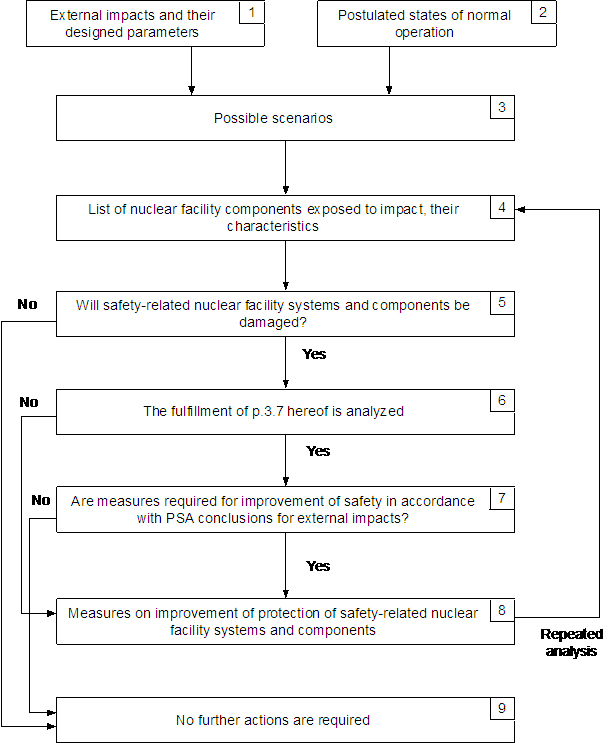
Appendix 8
to federal rules and regulations
in the field of nuclear energy use
"Record of external impacts
of natural and human-induced origin on nuclear
nuclear facilities",
approved by Order of the Federal
Environmental,
Industrial and Nuclear Supervision Service
dated 30 November 2017 No. 514
(for reference)
OF ORGANIZATIONAL AND TECHNICAL MEASURES FOR ENGINEERING PROTECTION OF
NUCLEAR FACILITY
FROM EXTERNAL IMPACTS
A List of technical measures taken for engineering protection on the nuclear facility deployment site
1. Regulation of level of surface and underground waters.
2. Construction of protective structures that protect slopes and banks from erosion, impact of landslides, earthfall and other processes.
3. Arrangement of retaining walls, buttresses, pile rows and other retaining structures that prevent displacement of earth masses.
4. Creating run-of-river hydrotechnical, mudflow-protective and mudlfow-diverting facilities.
5. Drainage of underground waters.
6. Reinforcement of grounds under foundations of structures.
7. Lightning protection of buildings, structures and industrial engineering lines.
8. Active corrosion protection of underground components of buildings, structures and engineering lines.
9. Arrangement of facilities for protection from flying objects in case of tornado.
10. The construction of tornado protective devices in the outdoor pools of security systems for limiting the entrainment of water from them by a tornado in excess of allowable limits.
11. Arrangement of barriers on the way of propagation of SAW.
12. Bounding or arrangement of ditches around the nuclear facility site area, arrangement of fire breaks and barriers to prevent propagation of of fire for external reasons.
B List of organizational and technical measures for engineering protection of nuclear facilities from external impacts
1. A list of organizational and technical measures for engineering protection of nuclear facilities from external impacts must generally include:
deployment of nuclear facility on a site, where there are no processes, phenomena and factors of natural and human-induced origin that do not allow the deployment of nuclear facility;
organizational and technical measures to ensure safety in case of adverse processes, phenomena and factors of natural and human-induced origin on the site;
design of stable "structure-foundation" systems;
ensuring the resistance of structures to extreme dynamic loads (from hurricanes, earthquakes);
reducing the level of dynamic loads transferred by the "soil-foundation-construction" system to the reactor, process and electrical equipment and other safety-related construction structures, systems and components of the nuclear facility;
ensuring protection of systems and components from dynamic impacts.
2. As typical seismic, shock and vibration protection measures it is recommended to adopt:
increasing the rigidity of structural components of building structures, equipment, fastening units, as well as application of devices for fastening of equipment, structures, pipelines;
reduction of dynamic inertial loads acting on the components of the object by seismic insulation of buildings, structures and individual premises, as well as equipment, pipelines, utilities;
limiting mutual relative displacement and deformation of components of equipment, structures, pipelines to avoid unacceptable deformations and collisions through the use of special restraints, deformation compensating fixtures, seismic isolation devices and dampers.
These activities can be carried out selectively or as a complex of measures.
Using seismic isolators or dampers must be substantiated in the project with:
calculation of efficiency of using the same;
experimental test of suggested devices or data of testing of their analogs.
Seismic isolators that have been experimentally tested and approved should be used. Preference should be given to devices that provide independent three-component seismic isolation and non-critical to the amplitude-frequency characteristics of the impact.
3. The resistance of the facility to loads of falling aircraft and other flying objects is ensured through:
increasing the area of sections of components of protective structures, the percentage of their reinforcement, the use of shock-resistant materials;
improved layout of the facility, redundancy of safety-related systems, physical separation of individual safety systems;
application of high-frequency vibration dampers installed on normal operation systems and safety-related systems;
provision of reliable fire-fighting equipment;
taking technical and organizational measures to protect against the secondary effect of the impact of flying objects (arrangement of protective barriers);
application of "sacrificial" structures or devices.
4. Protecting nuclear facilities from the danger of emergency external explosions can be solved by removing or shielding the source of the explosion or the consolidation of structures, buildings, structures of the nuclear facility (increase of the stiffness and inertial characteristics of sections).
5. To effectively improve fire safety in order to protect against fires for external reasons, the project should include:
redundancy of safety-related systems (components), allowing them to perform their functions in case of fire;
additional protective barriers;
spatial and physical separation of safety systems, their channels and control safety systems; protection of shutdown and cooldown systems of the reactor installation from fire hazards and ensuring that these systems perform their design functions during and after the fire;
rational layout solutions; separation of the process equipment, cable lines, pipelines and ventilation currents with fire prevention stops (barriers) and safe (ultimate) distances to exclude simultaneous impact of fire on the main and standby equipment;
sufficient thickness of concrete structures;
application of fire-resistant materials, meeting the requirements for fire protection of structures, premises, buildings, parts of buildings, depending on their fire resistance and (or) fire hazard;
fire-fighting systems including indoor and outdoor fire water pipeline systems;
adjustment of locations and quantities of combustible explosive and fire-hazardous mixtures and substances placed on the nuclear facility site;
using reliable systems of automatic fixed fire extinguishing systems for elimination and active localization of fire;
warning systems and prompt involvement of fire units, use of automatic fire alarm installations (systems), warning of employees (personnel) of the fire.
Ventilation systems should be designed with taking into account the postulated external fire.
6. Protection of systems against corrosive liquid discharges can be ensured through:
application of corrosion-resistant materials, protective coatings;
increasing the thickness of walls of pipelines and equipment;
application of protective sealed enclosures for electronic equipment and devices;
application of corrosive gas detectors regulating the operation of shut-off valves;
control of the chemical composition of cooling water.
7. For prevention of hazard from harmful (polluting) substances, the following means are applied:
toxicity detectors;
means for reduction of volume and concentration in the atmosphere of harmful (polluting) substances (ventilation, geometric flow separation);
personal protective equipment.
8. For protection against lightning strikes, electromagnetic pulses and radiation, the following means are used:
screens, optimal spatial arrangement of lightning protection systems;
lightning rods, arresters, grounding of separate parts of nuclear facility systems;
devices that prevent overvoltage in the most critical places;
protection of entries into the structure, along which penetration of induced currents and voltages is possible.
9. For the purpose of protection of the nuclear facility from penetration of oils and petroleum products into water supply systems, the following measures are taken:
furnishing water intake points with means for detection of oils and petroleum products;
arrangement of water intake nozzles above the water surface.
10. For protection of the nuclear facility from penetration of flora and fauna species into water supply systems, the following measures are taken:
furnishing water intake points withe means and devices preventing penetration of flora and fauna species.
11. Creating a hail protection service for nuclear facility located in hail-hazardous areas.